

SafeSnap
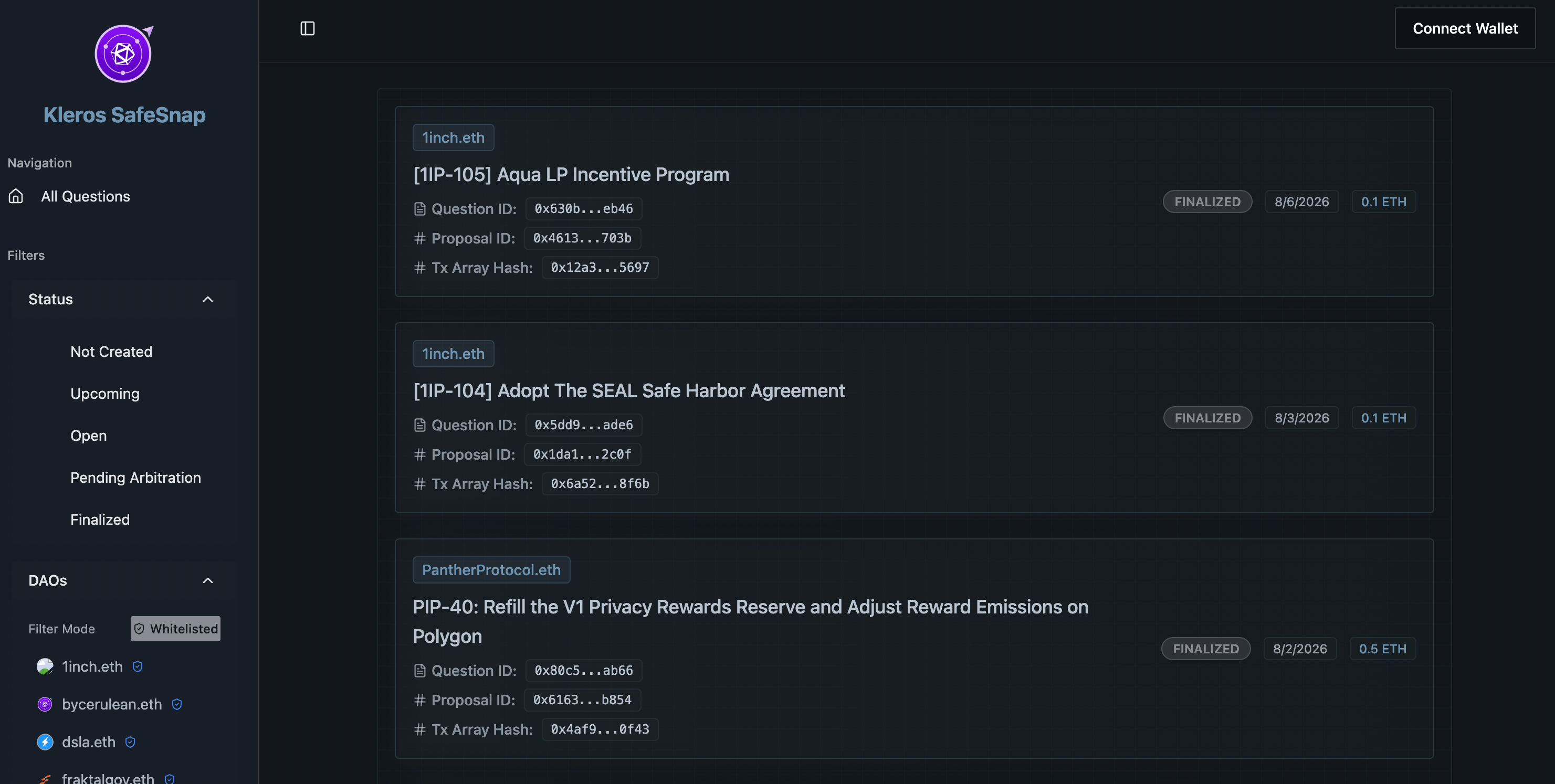
SafeSnap currently uses Kleros V1 for arbitration. V2 integration is planned.
The Problem It Solves
A DAO votes on Snapshot. Snapshot votes are off-chain signed messages — free, gasless, and invisible to the blockchain. The treasury, meanwhile, sits in a Safe that only responds to on-chain transactions. Something has to bridge the two. Conventionally that is a small set of multisig signers who manually execute what the vote decided. That reintroduces exactly the trust assumption the DAO was trying to remove: the signers can delay, refuse, execute something different, or collude. SafeSnap replaces those signers with an oracle plus an economic game, backed by a court.Key Capabilities
Trustless Execution
Snapshot vote outcomes execute against the Safe with no multisig signer in the loop
Permissionless Challenge
Anyone can dispute an incorrect execution request by posting a bond
Court Backstop
Kleros jurors rule on contested proposals against the DAO’s own requirements document
Components
A Zodiac module is a contract granted permission to make a Safe execute transactions. Unlike a signer, a module executes based on code, not a signature.
How It Works
1
Propose with a payload
A proposer creates a Snapshot proposal and uses the SafeSnap plugin to attach the exact batch of transactions that should run if it passes.
2
Vote off-chain
Voting happens normally on Snapshot — off-chain and gasless.
3
Post the question to Reality.eth
Once the vote passes, anyone can open a Reality.eth question asking whether the linked proposal passed, whether it contains this exact payload, and whether the payload does what the proposal describes, per the DAO’s requirements document.
4
Bond escalation
Someone answers and posts a bond. To contradict an answer, a challenger must post at least double the previous bond. The loser’s bond goes to the winner, so asserting a false answer is expensive and challenging a false answer is profitable. Most questions settle here without ever reaching the Court.
5
Kleros arbitration (only if needed)
Once bonds grow large enough that paying arbitration fees is cheaper than doubling again, either side can escalate to Kleros Court. Jurors read the proposal, the payload, and the DAO requirements document, then vote. The ruling is written back to Reality.eth and is binding.
6
Cooldown
After the answer finalizes, a cooldown period must elapse before execution. This is a deliberate safety window during which a clearly invalid outcome can still be reacted to.
7
Execute
Once cooldown ends, anyone can trigger execution from the SafeSnap panel on the Snapshot proposal. The Reality Module instructs the Safe to run the transactions. No signer approval is involved.
The DAO Requirements Document
This is the single most important configuration step, and the most commonly skipped one. Jurors do not know your DAO’s rules. When a proposal is disputed, they need a written standard to judge it against — quorum thresholds, supermajority rules for certain action types, formatting requirements, anything that makes a proposal valid or invalid in your DAO. That standard is a document uploaded to IPFS and registered as adaorequirements text record on your Snapshot space’s ENS name:
Monitoring Is Not Optional
Anyone can post a Reality.eth question and answer it — including for a proposal that never passed. The bond and the Court only protect the treasury if someone shows up to challenge before the timeout expires. That makes monitoring a load-bearing part of the security model, not a nice-to-have. Kleros maintainszodiac-bots, an open-source service that watches Zodiac Reality modules and pushes alerts to Slack, Telegram, or email when proposals and answers appear. It tracks one or more Snapshot spaces, identified by ENS name and a starting block:
SafeSnap vs. Kleros Governor
Both execute governance decisions with a Kleros backstop, but they solve different shapes of the problem.A Note on Naming
Three names circulate for closely related things:- SafeSnap — Snapshot’s name for the plugin. Legacy branding that stuck, and still the term most DAOs recognize.
- Zodiac Reality Module — the actual on-chain contract, part of Gnosis’s Zodiac standard. The technically correct name.
- Kleros Reality Module — a Reality Module configured with a Kleros arbitrator proxy.
Use Cases
Treasury management — Release grants, pay contributors, or rebalance holdings based on Snapshot votes, without a signer bottleneck. Progressive decentralization — A DAO can start with signers in place and remove them later, transferring full control to the module once governance is proven. Protocol parameter changes — Execute upgrades and configuration changes voted on by token holders.Known Considerations
Anyone can submit — Permissionless submission to the Reality Module is a feature, but it means malicious questions can be posted. Monitoring and an active challenger community are what make this safe. Bond exhaustion — A well-funded attacker can force repeated bond escalation rounds. Escalating to Kleros gives a fixed-cost resolution path when bonds become prohibitive. Snapshot voting is off-chain — SafeSnap secures the link between the vote and execution. It does not secure the vote itself; Snapshot’s own strategies and quorum rules govern that.What’s Next?
Set Up SafeSnap
Step-by-step deployment and configuration guide
Reality (Oracle)
How Reality.eth and Kleros arbitration work underneath
Zodiac Documentation
Official Zodiac Reality Module reference
Snapshot SafeSnap Guide
Snapshot’s plugin documentation